


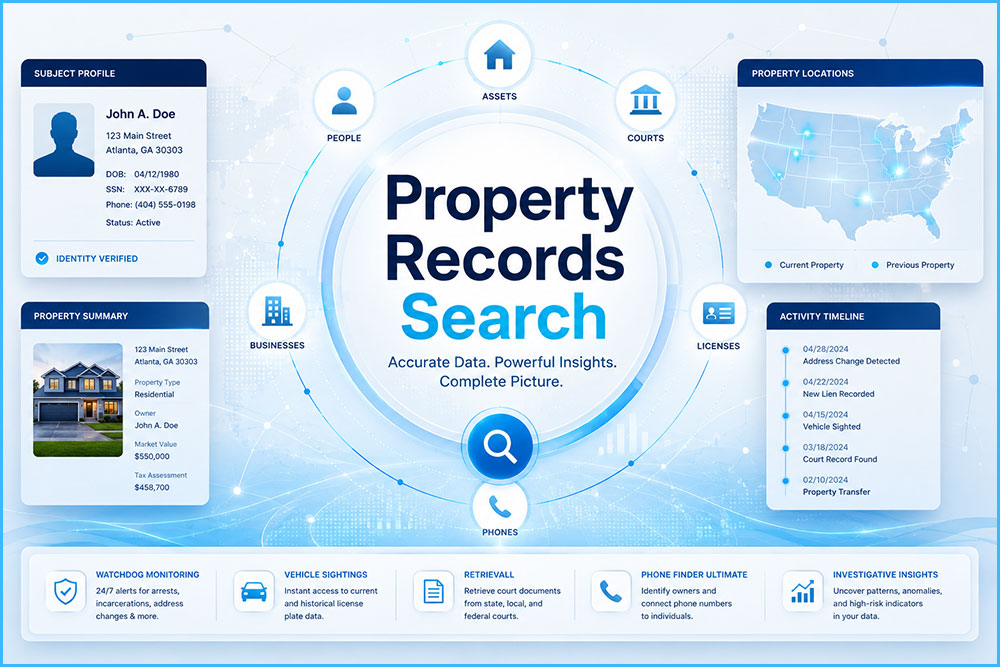
Property Records Search Guide for Investigators
Property records are a cornerstone of modern investigations. For private investigators, legal professionals, and process servers, these records provide verifiable connections between individuals, assets, and locations. When used effectively, property data can reveal ownership patterns, financial indicators, and jurisdictional ties that support casework.
This guide explains how to access property records, what to look for, and how to streamline the process using professional-grade tools.
What Are Property Records?
Property records are official documents that detail ownership, transfers, and characteristics of real estate. These records are typically maintained at the county level and may include:
- Deeds and title transfers
- Mortgage and lien filings
- Property tax assessments
- Parcel and zoning information
- Ownership history
Because they are public records, they can be accessed through local government offices or aggregated research platforms.
Why Property Records Matter in Investigations
Property data offers more than just ownership details. It helps investigators:
- Establish residency: Confirm where a subject lives or has lived
- Identify assets: Discover real estate holdings tied to individuals or businesses
- Trace relationships: Uncover connections through shared property ownership
- Support legal service: Verify addresses for process serving
- Assess account activity: Evaluate property values, liens, and mortgage activity
When combined with other data sources, property records contribute to a well-rounded investigative profile.
Common Challenges in Accessing Property Records
Despite their value, property records can be difficult to work with due to:
- Fragmented systems: Records are stored across thousands of county databases
- Inconsistent formats: Each jurisdiction may present data differently
- Limited search capabilities: Some systems require exact matches or parcel numbers
- Time-intensive retrieval: Manual searches across multiple counties can slow investigations
These challenges make it important to use tools that centralize and standardize access.
Key Elements to Review in Property Records
When conducting a property records search, focus on these critical components:
Ownership Details
- Current and previous owners
- Co-ownership structures
- Transfer dates
Financial Indicators
- Mortgage amounts
- Lien filings
- Tax assessment values
Property Characteristics
- Property type (residential, commercial, land)
- Square footage and lot size
- Year built
Transaction History
- Sale prices
- Frequency of transfers
- Patterns of acquisition or liquidation
These elements help build context around a subject’s financial and residential footprint.
Streamlining Property Research with IRBsearch
For professionals handling high volumes of investigative work, efficiency and accuracy are essential. IRBsearch offers a centralized platform that simplifies property record access across most states and U.S. territories.
How IRBsearch Enhances Property Searches
- Comprehensive Data Access: Search property ownership alongside People, Assets, Businesses, Courts, Licenses, and Phones in one place.
- Detailed Reports: Generate easy-to-read reports that combine property data with broader investigative findings, creating a 360-degree profile.
- RetrievALL Court Document Access: Seamlessly pull related legal documents that may reference property disputes, liens, or ownership issues.
- Investigative Insights Add-On: Identify patterns, anomalies, and high-risk indicators within property and asset data to support deeper analysis.
All reports can be exported as PDF making them easy to share and integrate into case files.
Best Practices for Property Records Searches
To maximize results, consider these strategies:
- Start with known identifiers: Use names, phone numbers, or addresses to initiate searches.
- Cross-reference data: Validate property findings with court records and business filings.
- Track historical changes: Ownership timelines can reveal important behavioral patterns.
- Expand geographically: Check neighboring counties or states for additional holdings.
- Document findings clearly: Organized reporting improves usability and case clarity.
The Role of Property Data in Modern Investigations
As investigative work becomes increasingly data-driven, property records remain a reliable and essential resource. They provide tangible, legally recognized connections that support a wide range of professional needs—from locating individuals to identifying assets.
With the right tools, property record searches can move from time-consuming tasks to streamlined workflows that deliver fast, actionable results. Ready to enhance your investigative workflow with faster access to property records and more? Get started with IRBsearch today.
RETURN TO BLOG HOME